Works Product & Engineering
Integrating with UKG: caches, credentials, and worker sync at hospital scale
What looks like 'call an API' ends up being a multi-quarter engineering investment when UKG is the system of record for who works where.


Blog
Product thinking, engineering deep-dives, company announcements, and perspectives from the team building Trusted.
What looks like 'call an API' ends up being a multi-quarter engineering investment when UKG is the system of record for who works where.
Forms were the answer when software couldn't understand sentences. Now that it can, we rebuilt clinician validations as conversation and let the model fill the form.
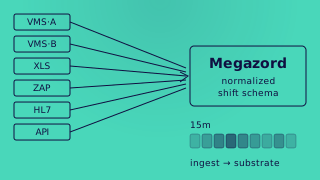
How we rebuilt shift ingestion as a time-blocked demand substrate, and why every higher-order feature in Works depends on it.
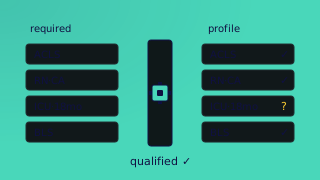
Qualification used to take 20 to 30 hours of advocate time per application. Here's the rules engine that does it as structured code, and the AI layer that handles what rules alone can't.
Nursys has been wired in since 2018, but it ran as an upfront check that still leaned on humans to read the results. In 2025 we rebuilt it as a real-time qualification rule.
Why clinical scheduling resists clean optimization, how we wrap a constraint solver in a pipeline a nurse manager can actually trust, and what it takes to ship the first live hard constraint.
Why flat shift bonuses fail the workers who already show up, and how gating incentive pay on FTE attainment rewrites the signal.
Each week, fifty-plus vendor management systems send us invoice data in their own format. Here is the four-step pipeline, the identity bridge, and the derived state machine that collapses all of it into one reconciled ledger.
Calls, SMS, email, and in-app messages all belong on the clinician's record. The hard part isn't capture. It's figuring out who you were talking to.
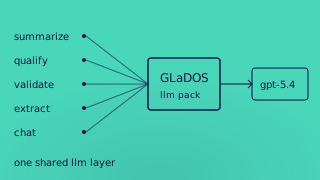
One shared pack runs every AI feature in our Rails app. Here's why building it once paid for the next ten features, and the pieces of GLaDOS that made that compounding possible.
A submission to a VMS isn't a form; it's an assembled document set. Here's how we encode every client's packet rules as data instead of code.